The EU AI Act’s label for AI-written comms.
Article 50 applies from 2 August. The exemption for human-reviewed text is narrower than most teams hope.
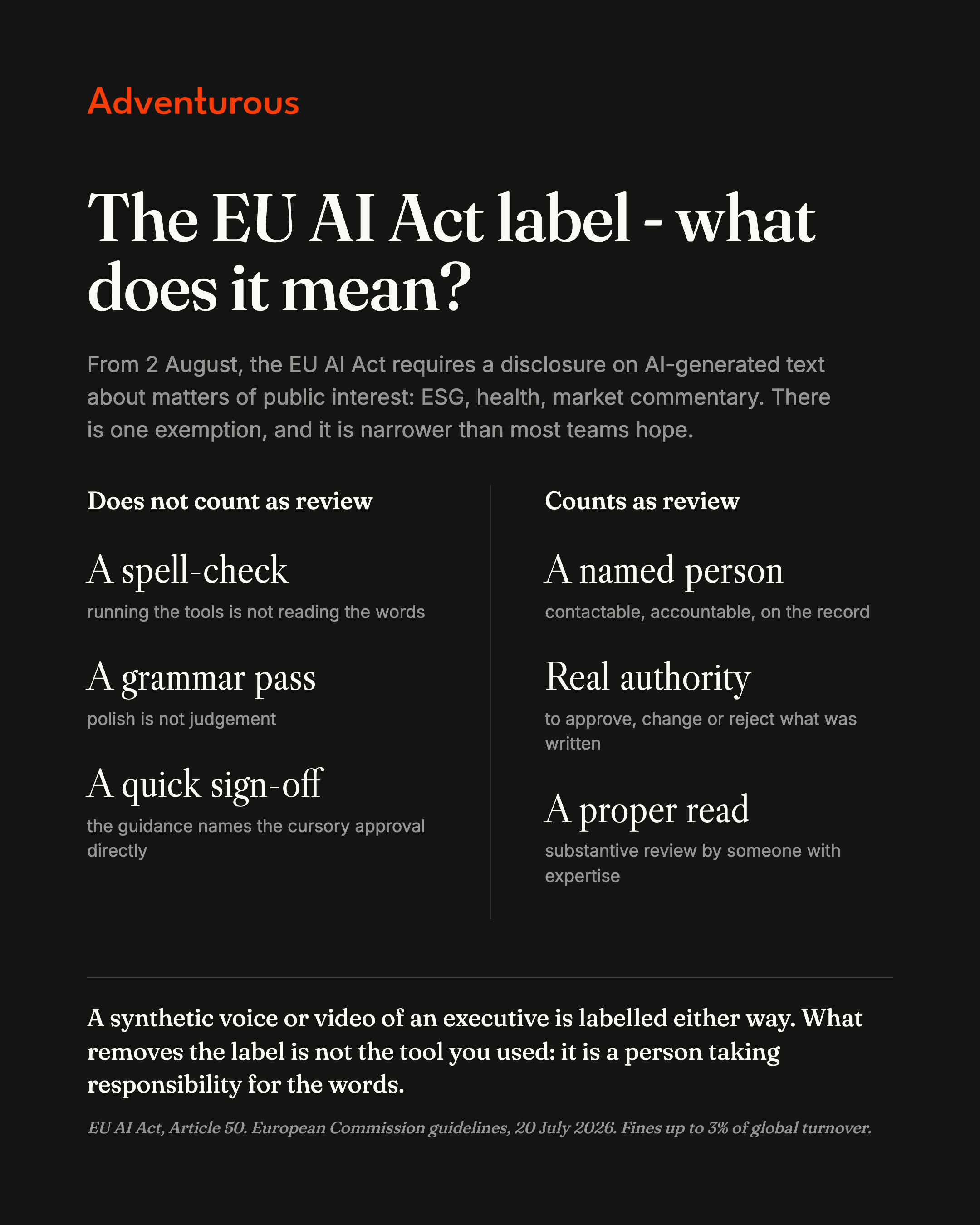
From 2 August 2026, AI-generated text published on matters of public interest must carry a disclosure under Article 50 of the EU AI Act, unless a person genuinely reviewed it and takes editorial responsibility for it. Spell-checks and cursory sign-offs do not qualify. Synthetic voice or video of a real person must be disclosed regardless of review. The compliant shape is a real editorial gate with a named, accountable reviewer.
What the rule says
The EU AI Act’s transparency rules, Article 50, apply from 2 August 2026. The European Commission published its final guidance on 20 July: 51 pages, 13 days before the deadline. Most in-house teams will go into August without a settled policy, through no fault of their own.
The rule itself is short. If you publish AI-generated text to inform the public on a matter of public interest, you have to disclose that it was AI-generated. And “public interest” is drawn widely enough to catch things comms teams publish every week: ESG reporting, health information, market commentary.
The exemption is the point
The obligation falls away where the text has gone through human review or editorial control. That exemption is where most comms teams will live, and it is narrower than people are hoping.
Per Greenberg Traurig’s reading of the guidance, spell-checking or grammar correction alone is not sufficient, and neither is a cursory editorial sign-off. What the guidance wants is a substantive review by a named, contactable person with the authority to approve, change or reject what was written. In other words, what gets you out of the label is not the tool you used. It is whether a real person took responsibility for the words.
Synthetic media is different
One part of the rule has no exemption. A synthetic voice or video of a real person, an AI avatar or a cloned executive voice, must be disclosed every time, whoever reviewed it. The guidance also wants that disclosure to be unmissable at the point of contact, not buried in terms. If your team is experimenting with AI presenters, that is a conversation to have with legal before August, not after.
How we think about it
We use AI inside our production chain daily, and every piece passes a person with real authority before it goes anywhere. Under these rules, that editorial gate is no longer just a quality standard. It is the compliant shape, and the documentation of who reviewed what becomes the audit trail. Fines run to 15 million euros or 3% of worldwide turnover, so the cost of being able to show your working is small by comparison.
Good editing was always the point. Now it is also the law.
Rethinking how your leadership communications are produced?
Our case studies brochure shows how we build executive voice inside enterprise communications programmes.
- EU AI Act, Article 50 (applies 2 August 2026).
- European Commission, guidelines on transparency of AI-generated content, 20 July 2026.
- Greenberg Traurig, analysis of the Article 50 guidelines, July 2026.