LinkedIn company pages are declining.
The reach has moved to people. For communications teams, that changes where the work sits.
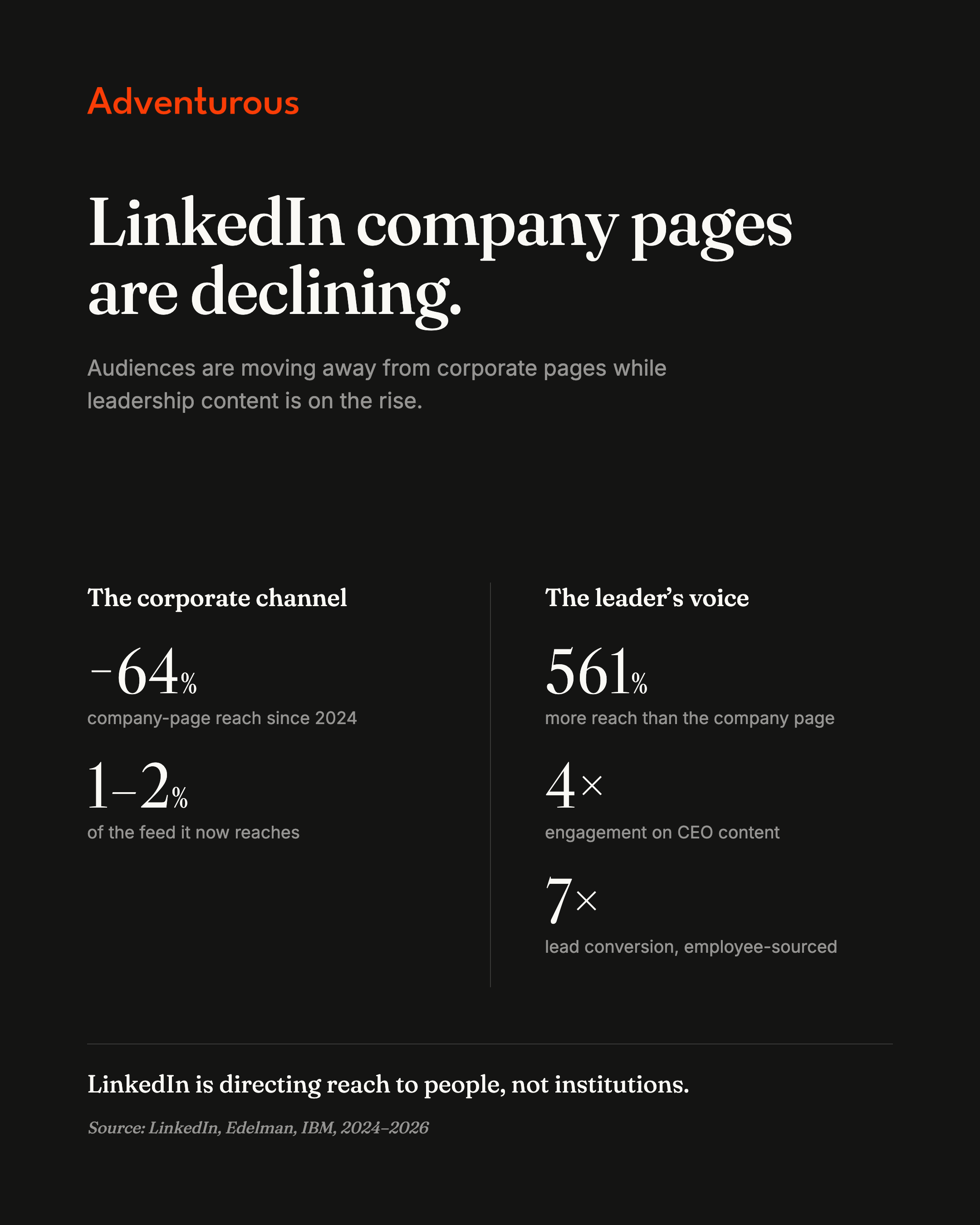
Company-page reach on LinkedIn has fallen by around 64% since 2024, and pages now account for only 1–2% of the feed. Personal profiles reach far more people, and audiences trust individuals over institutions. The practical response is not to post more from the company page, but to build a small number of credible leader voices and a cadence they can sustain.
The numbers
If your organisation runs a LinkedIn company page, the trend is worth knowing. Organic reach for company pages is down by roughly 64% since 2024, and pages now reach only 1–2% of the feed. Over the same period, personal profiles have pulled well ahead. An individual post reaches around 561% more people than the page it sits beside, and content from a chief executive earns about four times the engagement of the same message sent from a corporate account. Leads sourced through employees convert roughly seven times better than paid placements.
Why this is structural, not a dip
This is not a quirk of the algorithm that a better posting schedule will fix. It reflects where trust now sits. Edelman's 2025 B2B research found that 73% of decision-makers consider a leader's thought leadership more trustworthy than a company's marketing material, and 53% say that when the thought leadership is strong, the brand behind it matters less.
The reason is simple. Institutions speak in approved language. Individuals speak with a point of view, and audiences can tell the difference in half a sentence. LinkedIn is directing reach to people, not institutions, because that is what audiences had already chosen. A platform change made the shift visible; it did not cause it.
What it means for communications teams
The implication is practical. The company page is no longer the strongest channel inside LinkedIn, so it should not carry the weight of the strategy. The work moves to your leaders, and it breaks down into three steps.
First, identify the two or three leaders who have something real to say. Not everyone on the executive team needs a profile programme; a few credible voices outperform a crowd of reluctant ones. Second, build each of them a cadence they can sustain. The scarce resource is the leader's time, not ideas, so design the programme around the time they can actually give. Third, let the company page do what it is still good at: a credible, authoritative reference for people who come looking, rather than the place you expect to win attention.
How we think about it
We build and run executive communications programmes for large organisations on a daily and weekly cadence, and the data matches what we see in practice. Leader-hosted formats consistently out-reach institutional channels, and they do something a company page cannot. They develop the leader's voice, give emerging executives time on the record, and build a relationship with an audience that compounds over months and years.
The reach did not disappear when company pages declined. It moved to your people, and it can be built deliberately.
Rethinking where your leadership communications sit?
Our case studies brochure shows how we build executive voice inside enterprise communications programmes.
- LinkedIn company-page reach analyses (Refine Labs and aggregated platform data), 2024–2026.
- Edelman & LinkedIn, 2025 B2B Thought Leadership Impact Report.
- IBM employee-advocacy conversion data.