Most comms teams measure the wrong thing.
Boards fund what they can read in business terms. Most communications reporting is not written in that language.
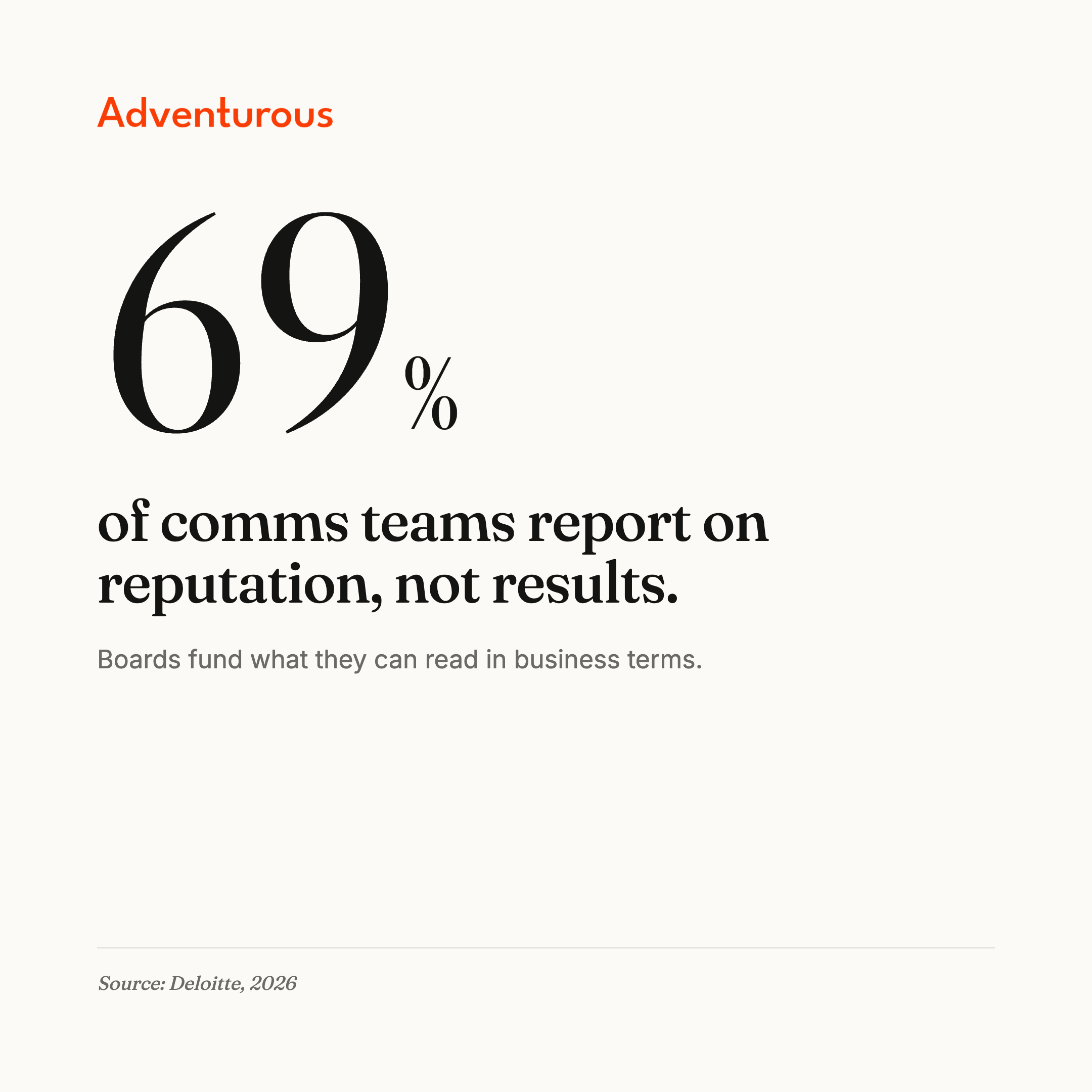
Deloitte found that 69% of corporate affairs functions report mainly on reputational metrics, and only 26% on economic ones. When budgets are set, boards approve what they can read in business terms. Measuring what a leadership communications programme actually changes, in that language, is what keeps it funded.
The number
In its 2026 research, Deloitte found that 69% of corporate affairs functions still report mainly on reputational metrics, and only 26% on economic ones. Most communications teams, in other words, are measuring how they are perceived rather than what they change.
That is understandable. Reputation is the discipline's traditional home, and reach, sentiment and awareness are easy to pull from a dashboard. The problem is not that those numbers are wrong. It is that they do not travel well into the rooms where money is decided.
Why it costs you at budget time
A board approves what it can read in business terms. When a function reports on awareness and sentiment, it is asking the board to take the value on trust. When it reports on pipeline influence, message pull-through, or the credibility a leader has earned on the record, it is speaking the language the rest of the business already uses.
This is the fork Deloitte describes between the communications function as an indispensable advisor and the function as a utility. The teams that keep their seat tend to be the ones that can show their work in terms a chief financial officer recognises. The teams stuck on reputation alone are the easiest line to cut.
What to measure instead
This is not about chasing a different set of vanity numbers. It is about measuring what a leadership communications programme actually moves, in language the people holding the budget already use. In practice, a few things are worth tracking.
Voice consistency: whether a leader sounds like themselves across formats and over time. Message pull-through: whether the points that matter are landing, not just the volume of output. Executive credibility on the record: whether leaders are becoming more confident and quotable, including to the AI tools that now answer a growing share of buyer research. And inbound quality: who is arriving, and whether they are the right people. None of these requires exposing confidential client data; they require deciding, up front, what the programme is for.
How we think about it
We build and run leadership communications programmes for large organisations, and we treat measurement as part of the design rather than a report bolted on at the end. The questions are agreed before the first recording: what should this leader be known for, what should move if it works, and how will we know. That turns the year-end review from a defence of the budget into a record of what changed.
If your communications reporting would not survive a finance review, that is the place to start.
Rethinking how you measure leadership communications?
Our case studies brochure shows how we build and measure executive voice inside enterprise programmes.
- Deloitte, Corporate Affairs research, 2026 (reputational vs economic reporting).